If you want more club head speed, physical development is crucial. The aim of this article is to clear up confusion about how exactly a golfer should train, and which exercises are best for club head speed.
I am going to give you the shortlist up front, then explain the rationale behind it. I want you to understand your training, not just provide another list of “best exercises for _____” that are all over the internet.
The Best Exercises For Club Head Speed At A Glance
If you just want the shortlist, here are the eight exercises, grouped into the three physical qualities you need to build.
Strength (build all round general size and strength, which will hugely increase your power potential)
- Deadlift: Quads, hamstrings, glutes, back, shoulders, forearms, and grip.
- Bench Press: Chest, shoulders and triceps.
- Pull-Up: Lats, upper back, biceps, forearms.With these 3 exercises, you can build a huge amount of total body muscle and strength. An important base for the power required for maximising club head speed.
Rate of Force Development (how quickly you can apply strength)
- Jumps: train explosive lower body power.
- Downward Med Ball Throws: train explosive power through the trunk and upper body, in a sequence very similar to the swing.
- Ballistic Push-Ups or Ballistic Bench Press: train explosive pressing power.These are excellent for training “power / explosiveness”, the ability to produce force very quickly. Combining strength training and power training is more effective than either on their own.
Swing-specific speed (train the skill and exact physiology of swinging fast)
- Overload and Underload Swings: swing training with a tool like the Stack System.
- Driver Swings With a ball and radar for feedback: training speed with actual implement used in the sport.
What The Research Actually Shows
A 2024 meta-analysis by Brennan and colleagues, published in the journal Sports Medicine, pulled together 20 studies and looked at which physical qualities are most associated with club head speed. Here is how the physical qualities ranked, from strongest association to weakest:
| Physical Quality | Association With Club Head Speed |
| Jump impulse | Large |
| Upper body explosive strength | Moderate |
| Jump peak power | Moderate |
| Jump displacement (jump height) | Moderate |
| Upper body strength | Small |
| Lower body strength | Small |
| Body size (anthropometry) | Small |
| Muscle capacity (endurance) | Trivial |
| Flexibility | No significant relationship |
| Balance | No significant relationship |
(Labels follow the effect-size bands used in the study: trivial, small, moderate, and large.)
The ability to produce force quickly sits at the top. In fact, the study found that explosive strength showed noticeably stronger associations than maximal strength, in both the upper and lower body. That fits with what happens in a swing: it lasts about a second, so how fast you can apply force matters more than how much you can grind out slowly. Maximal strength still matters, as it plays a big role in long term power development.
At the bottom of the table, you can see flexibility and balance showed almost no direct relationship with speed in the players that were tested.The research review does not prove mobility doesn’t matter. The authors point out that the flexibility tests used, things like the sit-and-reach, are not very golf-specific, and that the type of mobility that likely does matter, such as the ability to rotate through the hips and thoracic spine, was rarely tested well. Flexibility is also more individual than the other qualities: if you cannot get into the positions the swing requires, improving your range matters a lot; if you already can, more flexibility adds little. This is exactly why mobility remains a priority for senior golfers and anyone with genuine restrictions, even though it sits low on this particular table.
Check out our full Fit For Golf Mobility Guide here.
Two key points
This review shows correlation, not causation. The review lists the physical qualities that tend to show up in golfers who swing fast. It does not prove that training these specific things will increase your speed the most. It shows a relationship, which we can take into account when thinking about designing the most effective training programs. It is a starting point, not a finished answer.
Better swing mechanics let you use more of your physical ability. The strongest association in the whole study, jump impulse, came from a small number of studies on low-handicap and tour-level golfers. That matters. In a golfer with excellent mechanics, raw physical output transfers very well to the swing. In an amateur with a poor swing, it often does not. You can be very powerful and still leak most of it through poor sequencing. So the better your mechanics get, the more your physical qualities actually show up in your speed. It also means we should be a little cautious about assuming a number found in tour players applies identically to a mid-handicap amateur.
Keep both of those in mind as we get into the training.
Check out our article Swing Speed Training For Golf – The Fit For Golf Guide.
What This Means For Your Training
Focus On Adaptations Instead Of Exercises
Most golfers go looking for the “best exercises for club head speed” as if there is a magic list.. Simply do the exercises and your speed goes up. It’s a bit more nuanced than that.
It is not the exercise itself that matters most. It is the adaptation the exercise stimulates. In other words, from training a certain exercise, in a certain manner, what are you now capable of that you were not before? When you train with good structure and a high level of effort (critical), you increase the size and strength of your fast twitch muscle fibers, you improve how quickly your nervous system can recruit them, and you develop the tendons that transmit force more effectively.
Those adaptations are what produce speed. The exercise is just the tool that drives them, and many exercises do a very similar job for golfers.
Two quick examples make this clear.
A deadlift is an exercise. Bigger, stronger muscle fibers in your quads, glutes, hamstrings and back are adaptations. A deadlift is a good way to stimulate those adaptations, but so are plenty of other exercises. The adaptation is the point, not the deadlift itself.
A medicine ball chest throw is an exercise. An improved ability to recruit the fast twitch fibers in your chest, shoulders and triceps is an adaptation. Again, there are many ways to train that, and it is the adaptation that matters, not the throw.
Now, it is true that some exercises have greater transfer to the golf swing than others. But that transfer is worth very little if there is not much underneath it to transfer.
Picture a golfer with no mobility, no strength, very little muscle mass, and no explosive power. Give them only ultra specific swing-mimicking exercises and they might make some quick progress, but then stall out fast. The way these exercises are performed and prescribed they are often more “swing practice” than physical development. This golfer would be far better off combining general strength training to increase the size and strength of their fast twitch fibers, with the more specific golf like exercises. It’s also crucial these specific exercises are done with maximum power on each rep, so they are stimulating adaptations, and not just extra “swing practice”.
So the question is not really “which single exercise is best.” It is “which adaptations do I need, and how do I train them in the right order.”
Combining General and Specific Training – The Long Proven Athletic Formula
Every exercise done with the intention of increasing club head speed sits somewhere on a spectrum from general to specific.
At one end are general exercises. These build your overall physical capabilities: your size, your strength, your power. The focus is upgrading your basic physiology. Simply becoming a more powerful human all round. They may not look much like a golf swing, but they are transforming the same nervous system and muscles you use to swing the club. This is where most golfers get the biggest return, because most golfers are so underdeveloped physically that improving their general capacity pays off enormously.
At the other end are swing-specific exercises. These look and feel a lot like the golf swing, and they are almost a blend of speed training and swing training. The most specific things you can do are swinging a club or a speed-training tool as fast as possible. Med ball throws and explosive band and cable rotations in swing-like patterns sit close to this end too, but are not as specific.
The best athletes in the world have used a combination of general and specific training for decades, and maybe centuries. Anatoliy Bondarchuk is a good example. He won Olympic gold in the hammer throw in 1972 and then became one of the most successful coaches in the history of track and field, with his athletes dominating at the Olympic level for years. The principle that runs through his work is exactly this one: you build a big base with general training, and “sharpen the peak” as an athlete develops.
To be clear, this is not about delaying your specific training. You should be doing both. What changes is the balance between them, and that balance depends on your background and current level.
An elite athlete with decades of training behind them has already squeezed most of what they can out of general training, so they lean hard towards specificity, especially at certain times. Regular golfers generally never come close to this level, and barely scratch the surface of what general strength and power could give them, so they have enormous gains waiting.
This general training is also absolutely non-negotiable for fighting off aging. We must work hard to maintain or develop our muscle mass, strength, and power. We should not neglect it by chasing swing-specific exercises, just because improved golf performance or club head speed are important goals.
The Axe and The Tree
A simple way to think about this balance of general and specific is cutting down a tree, where your general training level is the size of your axe, and specific training is how sharp your axe is.
If you only ever do specific work, you might be sharpening a very small axe. You can get it razor sharp, and you will see some quick early gains, but you are refining something that does not have much behind it. You hit a low ceiling fast.
The solution? Increase the size and strength of your fast twitch fibers and how quickly your nervous system can recruit them through strength and rate of force development training. Now you have a bigger axe. Sharpening that with specific training and cutting down trees will be a lot easier!
General training builds the raw materials. Specific training shapes it for how you want to use it. Combining both is where the biggest results come from.
This is exactly how the Fit For Golf programs are built. They are periodised and combine general and specific work in the right proportions, so you are always developing both without having to work out the balance yourself.
That is the framework. Now the exercises, in three tiers.
The 3 Best Strength Exercises For Club Head Speed
Strength training builds your foundation. It is particularly beneficial for improving the size of the fast twitch muscle fibers, which allows them to contract with more force when used in the swing, and also enables us to recruit more of these fibers. I went into great detail about this in Strength Training For Golf – The Fit For Golf Guide.
The aim here is to train the key muscle groups throughout the body with as few exercises as possible. Exercises that can be incrementally progressed for a long time and train multiple muscle groups at once are my preference. The three listed below train just about everything that contributes to a powerful golf swing: a strong lower body, a big upper body push, and a big upper body pull. Get very strong in these three and you have built a serious engine.
A note on tracking strength: the best metric to watch is your 5 rep max. Keep nudging up the weight you can lift for 5 reps and you will be making big gains. This also lines up with what the research suggests: the authors recommend gym training for golfers should focus on maximal strength and explosive force with lower repetitions, rather than the high-rep, endurance-style work that turns out to have almost no relationship with speed. For pull-ups, once you can do 5 reps with good form, start adding weight and treat them the same way. (It doesn’t have to be exactly 5 reps, but close to this rep range is ideal).
1. Deadlift
The deadlift gets the nod because of the sheer amount of muscle mass it trains. Quads, hamstrings, glutes, the entire back, and even the upper body, since gripping a heavy bar is hard work in itself. When you are focusing on a small handful of exercises, nothing else gives you this much for one movement.
It does not have to be a conventional deadlift from the floor. For most golfers I recommend elevating the barbell significantly off the ground, or using a hex (trap) bar, which is easier on the back and lets most people load it well. You could also make a case for a squat or split squat in this slot, and both are excellent. I lean towards the deadlift for the total muscle mass involved and the load you can handle.
I recommend using lifting straps and a belt as you begin to lift very challenging weights.
2. Bench Press
The bench press allows for huge upper body loading, more so than almost any other upper body exercise. Chest, shoulders and triceps are all working hard, and with the whole body bracing it is almost a full-body lift. It is worth noting the research points specifically to multi-joint upper body lifts like the bench press as the sensible choice, over machines or isolated movements. The bench is one of the best tools available to build the upper body strength that the faster, explosive work then sits on top of.
When bench pressing, I recommend setting up safety bars or using a spotter. Bench pressing alone without safety bars is the most dangerous exercise you can do, so alternatives can be done in place of it. If bench pressing alone, make sure to never put collars on the sleeve of the bar. You want to be able to tip the weights off if something goes wrong.
3. Pull-Up
In my opinion the pull-up is the best pulling exercise there is. If you are strong at pull-ups, you will have very strong lats, and the lats are critical for club head speed. You could argue for a single-arm row in this slot, and it is a fine exercise, but I like golfers to focus on getting strong at pull-ups. Once someone can do 5 pull ups, I recommend adding weight. My preference is a slightly wider than shoulder width overhand grip, and a complete extension of the arms at the bottom of each rep. By coming to a full hang between reps, shoulder mobility and lat flexibility is enhanced.
If you are not currently able to perform pull ups with your bodyweight, you can use the assistance machine in the gym, or wrap a band(s) around the bar and your foot. Perform sets of 5 reps, and gradually reduce the assistance as you get stronger.
One of the main reasons for struggling with pull ups is excess body fat, so there is also incentive to get lean, which is very important for general health and longevity.
The 3 Best Power Exercises For Club Head Speed
In conjunction with building strength, it is important to work on improving how quickly you can produce force. This quality is often referred to as “power” or “rate of force development”. It is also lost much faster than strength as we age, which is a big reason golfers lose speed over time. Strength is the maximum force you can produce in a certain movement; rate of force development is how quickly you produce a certain amount of force. This is important, because as the golf swing is a very fast movement with a very light implement, we need to be able to produce force quickly to produce high club head speeds.This is in contrast to something like a heavy set of squats or bench presses, where you can strain against the weight.
The most effective combination is training strength and power.
In this list there is a lower body exercise, a full body rotational exercise, and an upper body exercise. The key with all of them is intent. Every rep is done with as much power as you possibly can. Light exercises with low intent do absolutely nothing to stimulate adaptations..
About 5 reps per set works well here, the same as the strength work. As the reps climb, fatigue builds and you start to slow down, which defeats the purpose. If you want more volume, add sets rather than reps, and stop well before you are gassed or grinding. Staying fast is the whole point.
1. Jumps
Jumping is an extremely simple and scalable way to work on lower body power. With power and strength exercises we should choose options where there is little technical complexity, as we can then focus entirely on force production. It doesn’t get much simpler than jumping. All you are doing is trying to jump as high as you can.
For those with injury concerns, jumping onto a low box, and then stepping down is a nice way to reduce landing stress. For those who cannot jump at all, explosive kettlebell swings are a good alternative.
2. Downward Med Ball Throws
It’s clear to see that these are a more “golf specific” option, in terms of movement pattern. They allow you to train force production in a sequence and time frame quite similar to the swing. I have grown to really like this med ball throw option, and end up including it in most workouts. I am bouncing the ball off the floor and then into some plyometric boxes. If you don’t have anything to rebound it off, you can simply bounce it off the floor just in front of your trail foot so it bounces up into your hands.
This exercise is a good example of “sharpening the axe”. Yes, it’s specific and has nice transfer, but if you only ever did this exercise and never got generally stronger, your overall progress would stall quickly. Conversely, if you took someone who had never done this exercise, but was very strong and powerful from general training, they would progress at it quickly.
View our Med Ball Exercises for Increasing Swing Speed article here.
3. Ballistic Bench Press Or Explosive Push-Ups
I view “ballistic push-ups” as jumps for the upper body. The only caveat to these is that if your upper body is weak, or you carry a lot of body mass, then these aren’t really a power exercise, as you cannot propel yourself very explosively.
In these scenarios a light weight explosive bench press is a great alternative. It’s also worth noting the height of the hand elevation can be changed on the ballistic push-up to suit strength level. I don’t really go lower than the bench, as I want to keep the speed high, but it can certainly be made higher.
The Best Swing-Specific Speed Exercises
This is the most specific end of the spectrum, where you take the strength and power you have built and express it in a movement that closely matches the golf swing itself. These two options are as close as you can get to training pure speed in a golf-specific way: one using speed-training tools, and one using your actual club. This is where the base you have built gets converted directly into club head speed. This is the part of training that is both “golf swing practice” and “working out”, it can’t really be separated.
1. Overload And Underload Swings
Swinging weighted (overload) and lighter than normal (underload) implements as fast as you can has proven to be an extremely powerful strategy for increasing swing speed. This is partly due to the adaptations to the nervous system and muscles, but also tends to improve swing sequencing. The Stack System is built specifically for this, giving you the protocols and the feedback to push your speed up over time.
2. Driver Swings
The most specific thing you can do is swing your actual driver with the goal of ramping up your club head speed. I prefer to do this hitting a real ball or a foam ball as it’s more representative of the real skill. Use a radar for feedback and work at pushing the number up over time.
I wrote Swing Speed Training – The Fit For Golf Guide so you can learn everything you need to know about speed training for golf.
A Sample Club Head Speed Workout
Here is a simple way to combine these exercises into a session you can run twice a week. It covers power and strength, which is where most golfers should spend the bulk of their gym time.
Notice that the power work comes first. Power is best trained when you are fresh, before strength work has fatigued you, and a few explosive efforts also serve as a great final warm-up for the heavier lifting that follows.
Power section (after a thorough warm-up)
- Jump x 5
- Downward Med Ball Throw x 5 each side (2kg / 4lb ball)
- Hands-Elevated Ballistic Push-Up x 5
Run this as a circuit for 3 rounds, with about 45-60 seconds between exercises and between rounds. Do not rush through it, we are not training endurance, we are training explosive power.
Strength section
- Deadlift x 5
- Bench Press x 5
Do 3 sets. You can run it as a circuit with 2 minutes between exercises and sets, or do each exercise on its own with 3 minutes between sets.
- Split Squat x 5
- Pull-Up x 5
Do 3 sets. You can run it as a circuit with 2 minutes between exercises and sets, or do each exercise on its own with 3 minutes between sets.
Add the swing-specific speed work (overload and underload swings, and fast driver swings) on separate days or after this session, once you are warm and not fatigued.
Want To Start Optimising Your Swing Speed Training?
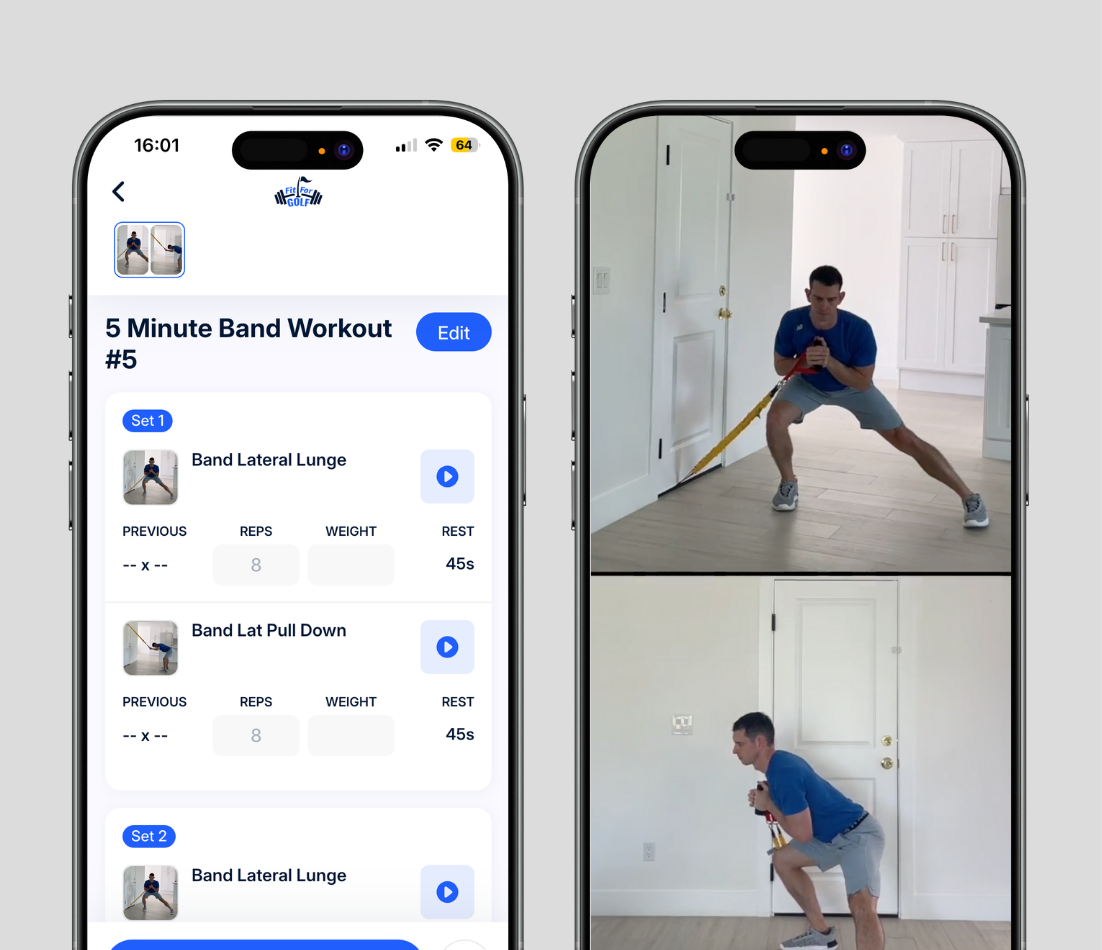
If you enjoyed the information in this article and it’s a little bit different to how you have been training, you should try out the Fit For Golf App.
The programs are designed with these concepts in mind, and there are options for all fitness levels, whether you workout at home with limited equipment or in a full gym. Everything is laid out for you with video demonstrations for every exercise and progress tracking so you can easily track your progress.
Frequently Asked Questions
What is the single best exercise for club head speed? There is not one. The research points to explosive, whole-body force production, so if you forced me to pick one movement it would be a jump or a med ball throw, trained with maximal intent. But no single exercise works in isolation. You need strength underneath the power and speed work on top of it. The combination is what matters, not any one exercise.
Does strength training really increase club head speed? Strength provides a great base that power and speed can be built on. On its own, getting stronger will help most golfers, because most are so underdeveloped. To get the most out of strength training for club head speed, it should be combined with power and specific swing speed training.
How long does it take to increase club head speed? It’s very common for golfers to gain 5 to 7mph of club head speed, worth about 12-20 yards of distance, within 12 weeks.
Does flexibility or mobility increase club head speed? For some golfers, yes. If a lack of mobility is stopping you from getting into the positions the swing needs, improving it can free up real speed. But in the research, flexibility on its own showed almost no direct link with club head speed, and the golfers tested were already quite mobile. Mobility matters most for seniors and anyone with genuine restrictions. For everyone else, it is generally overvalued next to strength and explosiveness.
How often should I train to increase club head speed? Two to three focused training sessions a week is enough for most golfers to make strong progress, with swing-specific speed work added on separate days or before those sessions. This is all explained in my two guides:
Strength Training For Golf – The Fit For Golf Guide
Swing Speed Training For Golf – The Fit For Golf Guide
Reference
Brennan, A., Murray, A., Mountjoy, M., Hellstrom, J., Coughlan, D., Wells, J., Brearley, S., Ehlert, A., Jarvis, P., Turner, A., & Bishop, C. (2024). Associations Between Physical Characteristics and Golf Clubhead Speed: A Systematic Review with Meta-Analysis. Sports Medicine, 54(6), 1553-1577. https://doi.org/10.1007/s40279-024-02004-5