Before you spend time training your mobility for golf, it helps to know where you actually stand. This article gives you a quick mobility assessment you can perform on yourself at home, targeting the key areas that matter most for the swing.
If you’d like the complete breakdown of mobility for golf, including what limits it, how much you need, and how to train it, check out the [Mobility For Golf guide].
This article is primarily theoretical, but I did want to provide you with a very quick mobility assessment you can perform on yourself. All of these tests are taken from the TPI Level 1 assessment, and target key areas.
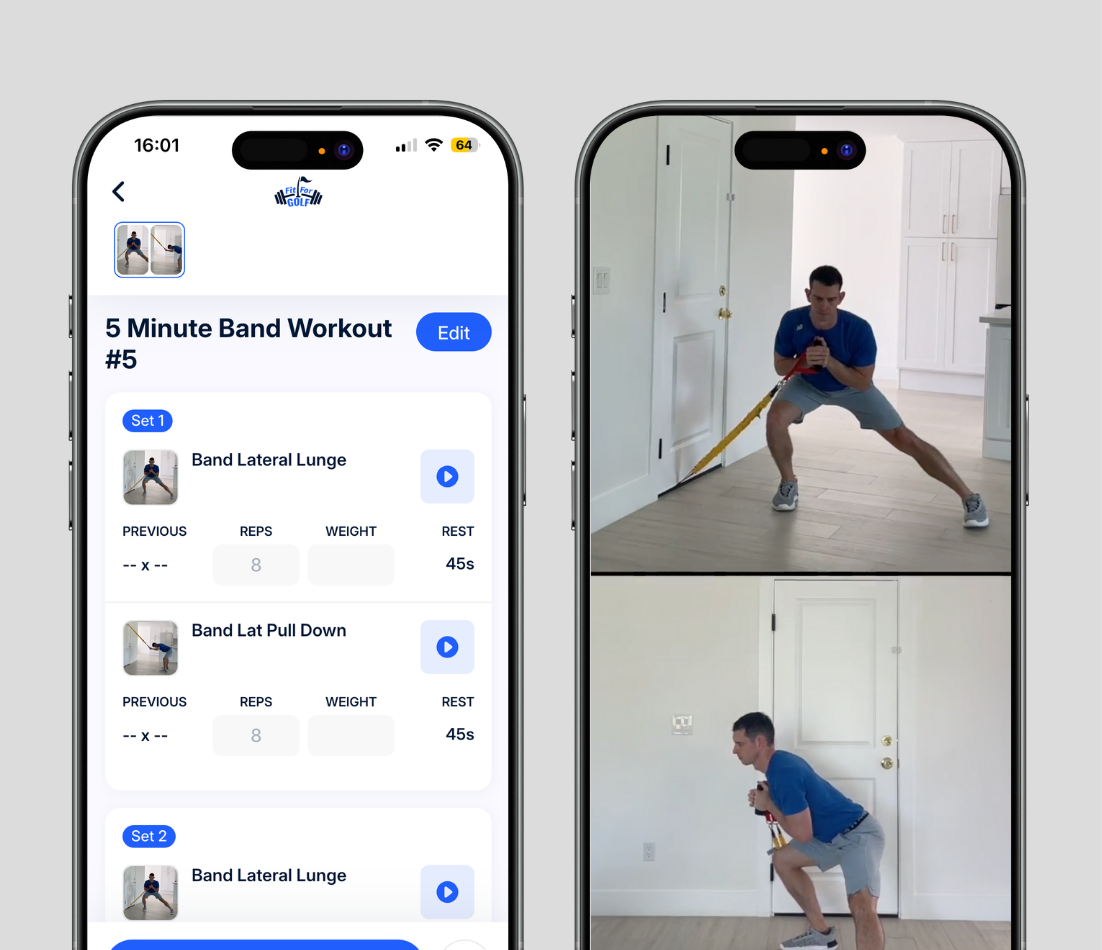
If you are interested in seeing the full TPI Level 1 Screening, and my interpretation of the value of the different exercises included, check out the TPI Screen, Self Assessment Guide in the Fit For Golf App. It’s in the “Golf Warm-Ups & Mobility Routine” Section.
It’s common to assign “pass” or “fail” gradings to exercises in screenings. I am not a fan of this, as it misses out on key context. For example, in test #1, Lower Quarter Rotation, the shaft on the ground represents a 60 degree angle. This range of motion is quite difficult, especially for the internal rotation test. Most people fail. However, someone “failing” at 55 degrees, versus 30 degrees is obviously quite different. There is a 25 degree difference in range of motion, versus a 5 degree difference between 55 and 60 degrees, which is pass. In this example, the golfers with 30 and 55 degrees are lumped in the same category as “limited internal hip rotation”, yet the golfer with 55 degrees is much closer to the 60 degree “pass mark” than they are the other golfer that “failed” with 25 degrees.
My point is to use these as gauges for where you currently are, and see if you can improve. This is much more beneficial than thinking you can’t do X in your swing because you “failed” Y test.
Lower Quarter Rotation
Seated Thoracic Rotation
External Shoulder Rotation
Shoulder Flexion
Interpreting What You See
How these exercises feel and respond to repetition and target work is important.
If a movement improves noticeably with warming up or repetition, the nervous system is likely the main limiter. In these cases, regular exposure, slow rehearsal, and controlled movement through the range are often sufficient.
If a movement presents as a hard block that does not change with warming up or repeated attempts, or is painful, it is likely structural. In these cases, the goal is not to force more range, but to work within what your structure allows and organise the swing accordingly.
Understanding which category you fall into prevents you from wasting time and effort that could be spent on more trainable things.
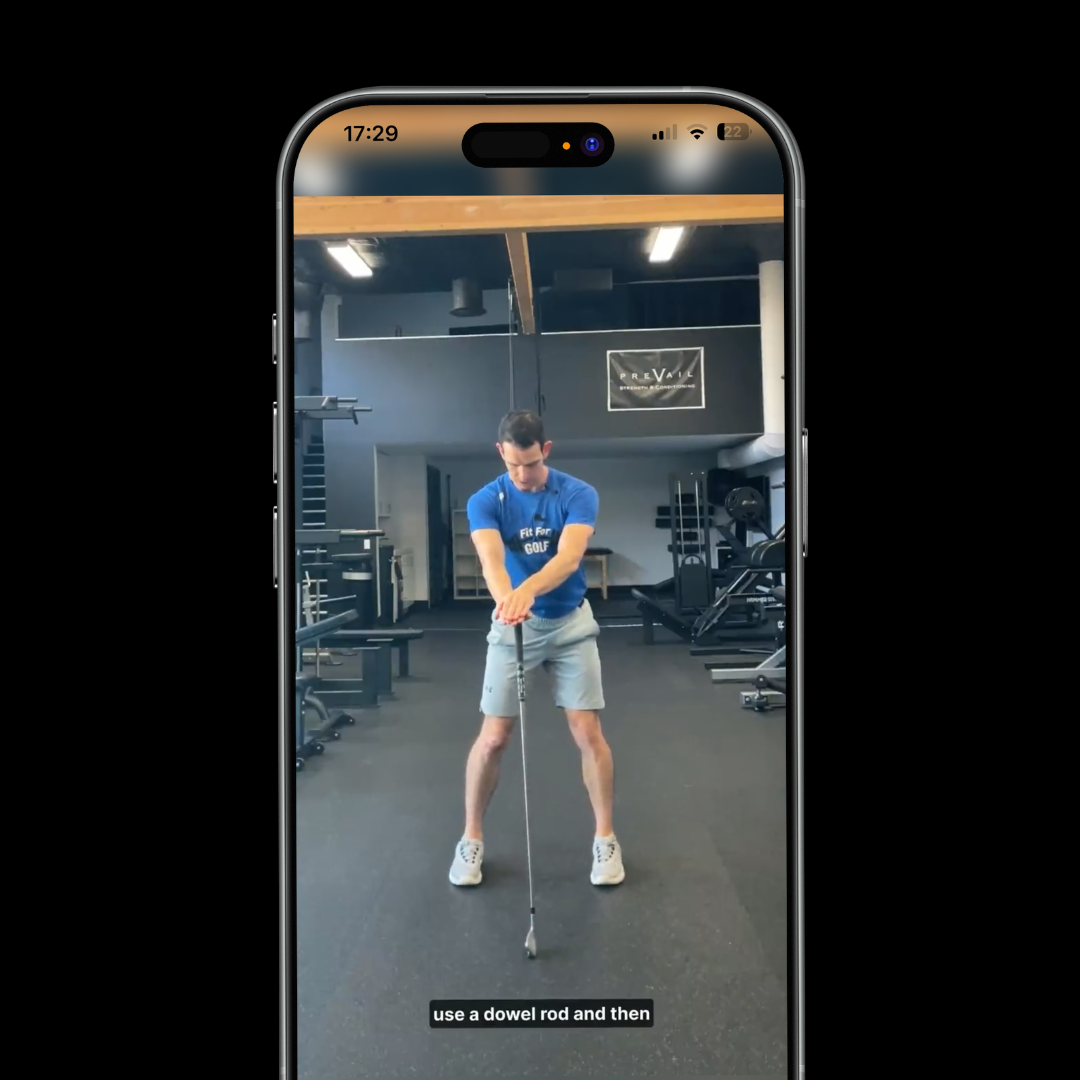
Free: TPI Self-Assessment Guide
The full TPI Level 1 screen with clear video demonstrations and benchmarks, plus a matching exercise for each test. Inside the Fit For Golf App.
For the complete breakdown of mobility for golf, including what actually limits it and how to train it sensibly, check out the Mobility For Golf guide.