Can you gain club head speed and distance without a gym, without a swing coach, and without hitting balls?
A group of researchers at the University of Pittsburgh tested exactly that. They took 15 male golfers, tested them on a launch monitor, gave them a program to do at home 3 to 4 times per week, and told them not to play or practice for 8 weeks. After 8 weeks, they retested.
Here is what happened.
Results
| Measure | Before | After | Change |
| Club head speed | 94.9 mph | 100.0 mph | +5.1 mph |
| Ball speed | 135.8 mph | 143.2 mph | +7.4 mph |
| Carry distance | 211.8 yards | 229.4 yards | +17.6 yards |
| Total distance | 226.8 yards | 243.3 yards | +16.5 yards |
These are very encouraging results for an unsupervised home based program of bodyweight stretching, resistance band exercises, and balance exercises.
The Subjects
The study consisted of 15 male golfers with an average age of 47 and an average handicap of 12. They all played 2 to 3 times per week during golf season.
I think this group is quite representative of a lot of the “eager golfer” population. These weren’t elite players or complete beginners, and they were at an age where most people have noticed some physical decline and question if it’s “too late” to make progress.
The study was conducted during the off-season, and the golfers were asked not to play, not to practice, and not to take any lessons. The researchers checked their training logs at the end to confirm they had stuck to it.
I think this is an element of the study worth taking note of. If a golfer gains distance when a number of variables have changed it’s hard to know what contributed. Here, the training was the only variable that changed, and if anything, not swinging for 8 weeks was a disadvantage and would have limited their gains.
The Golf Specific Training Program
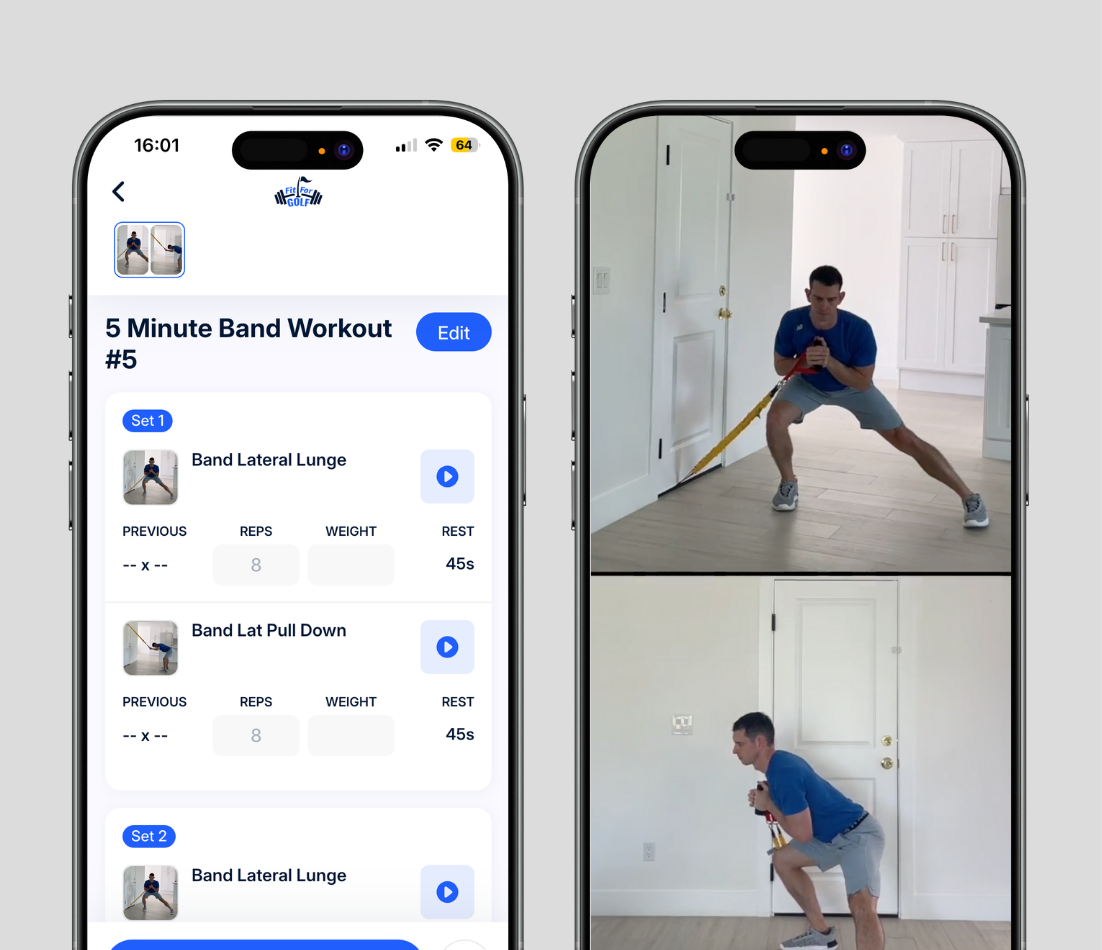
All of it was done at home. Each golfer got a 6ft / 1.8m length of elastic resistance tubing with a handle and an anchor, plus a small foam pad for the balance work.
These are the exact same type of bands I use for the Band Programs in the Fit For Golf App. <insert video of band exercises from my house in the app>
Each workout consisted of 3 elements.
Stretching
Each stretch held for 30 seconds.
- Supine hip flexion
- Prone torso flexion
- Kneeling lunge
- Seated hip rotation
- Seated torso rotation
- Seated torso rotation holding a club behind the neck
- Standing lateral bending
Resistance band strengthening
3 sets of 10 to 15 reps, both sides, at a controlled 2 second concentric / lifting phase and 2 second lowering / eccentric phase.
- Hip abductions
- Hip adductions
- Scapular retractions
- Resisted backswings
- Resisted downswings
- Resisted through-swings
- Abdominal crunches (bodyweight)
Balance
2 sets of 30 seconds per leg.
- Isometric squat (this isn’t actually a balance exercise, it’s a leg strength exercise)
- Stand on one leg
- Stand on one leg on a foam pad – the foam pad is less stable than the floor, challenging balance more
Progressing The Difficulty of The Exercises
If you’ve read my blog post Strength Training For Golf – The Fit For Golf Guide, you will be familiar with the critical importance of progressive overload. This means making workouts more difficult over time, to encourage the body to continue making adaptations.
It was good to see the researchers encouraged this. They instructed the subjects to move further away from the anchor point of the band as soon as they could comfortably complete 3 sets of 15 repetitions. That increases the tension in the band.
That is progressive overload. It is the mechanism that makes this a training program rather than a routine you repeat until it stops working. If you take one thing from this article, take that.
Strength Progress
The golfers got stronger and more mobile in specific places.
Torso rotation strength improved significantly, with the largest gain of 13.3% on right torso rotation at the faster testing speed. This test was done on an isokinetic dynamometer.
Hip abduction strength improved on both sides, 8.6% and 9.9%. Hip abduction is a measure of glute medius strength. Hip adduction did not change significantly.
Every single range of motion test improved. Shoulder, hip, knee and torso rotation, all of them. This is good evidence for simple stretching being effective for increasing range of motion.
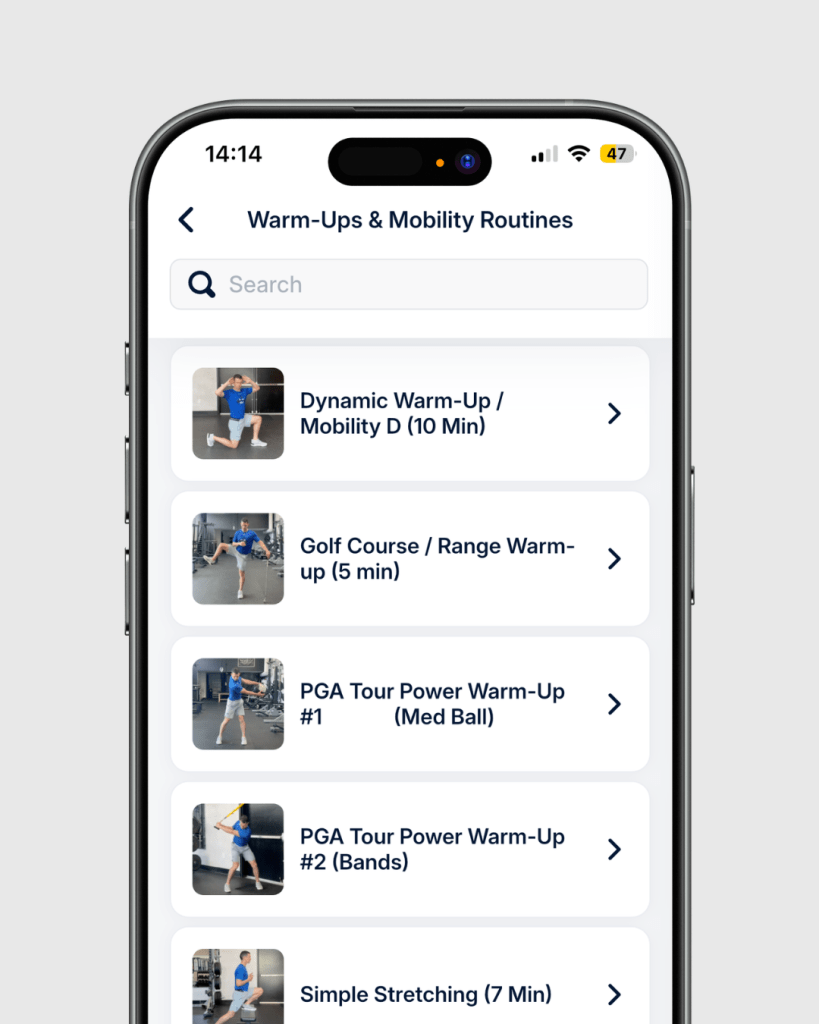
The Fit For Golf App has a golf specific mobility section.
Balance improved across the board, though only 3 of the 12 measurements reached statistical significance.

Resistance Band Home Workout
Download a FREE resistance band workout for golfers.
What Changed In Their Swings
Assessing how the golfer’s swings mechanically changed is interesting, because the program was not designed as a “swing change plan”.
Rotation at the top of the backswing
| Measure | Before | After | Change |
| Pelvis rotation | 56.1 deg | 49.4 deg | 6.7 deg less (13.4%) |
| Upper torso rotation | 106.4 deg | 102.6 deg | 3.8 deg less (3.8%, not statistically significant) |
| X-factor | 49.8 deg | 53.5 deg | 3.7 deg more (6.8%, not statistically significant) |
A reduction in pelvis rotation at the top of the backswing was the only measure that reached statistical significance. The upper torso barely moved, so the gap between the two, the X-factor, widened. Previous research is mixed on whether X factor at the top of the backswing is a contributor to increased club head speed.
Rotational velocity at the acceleration phase of the downswing
| Measure | Before | After | Change |
| Upper torso | 588 deg/s | 633 deg/s | +7.0% |
| X-factor velocity | 204 deg/s | 237 deg/s | +14.0% |
| Pelvis | 385 deg/s | 396 deg/s | +2.8% (not significant) |
In the downswing, the golfers increased their torso rotation speed, and the speed at which their X factor closed.
The authors’ explanation is that stronger hips and a stronger trunk gave them a more stable pelvis to rotate against, and better torso mobility let the upper body move freely against it. More coil in the backswing, and a faster unwind in the downswing.
Could The Program Have Been Better?
A very basic program produced these benefits. A few things stand out to me that could be tweaked to make it even more effective for building speed.
Repetition Tempo
The program used a 2 second concentric / lifting phase and 2 second eccentric / lowering phase tempo on every rep of the strengthening exercises.
For developing speed and power, moving with maximum explosive intent on the concentric / lifting phase has more scientific support. This is because it recruits and trains more fast twitch muscle fibers.
In my programs I recommend moving the load with explosive intent on every rep.
Repetition Range
3 sets of 10 to 15 reps is moving slightly away from the explosive power development most suited to increasing club head speed, and more towards “general conditioning”.
I would rather see sets of 5 to 8 reps, with the band stretched considerably further from the anchor, combined with a higher effort level on each rep.
I cover this in detail in my article: Strength Training For Golf – Heavy vs Light Loads.
Study Limitations
There was no control group in this study. The golfers were tested, they trained for 8 weeks, and then they were tested again. That is worth knowing when I say the training was the only variable that changed. Strictly, we cannot rule out every other explanation for the improvement.
I am not too worried about it here. The golfers did not play, practice, or take a lesson for the full 8 weeks, and their training logs were checked at the end to confirm it. The gains are also far too large to write off as testing error or chance. But it is correlation with a very strong case behind it, not proof.
15 golfers is also a smaller group size, but that’s not to dismiss the results achieved in this study.
The Takeaway
You do not need a gym, heavy weights, or hours of your week to swing faster.
A simple program of stretching, resistance bands and balance work, done at home 3 to 4 times per week, produced 5 mph of club head speed and 18 yards of carry in 8 weeks.
Some people spend hundreds of dollars on a new driver that cannot come close to a gain like this. Invest in your physical training instead and you get the extra distance plus better health, strength and fitness that a driver will never give you.
It is also worth noting the golfers likely gained distance with every club in the bag, not just the driver. So, they are not only closer to the hole off the tee, they can hit a shorter, more lofted club into every green, which is easier to control and stops faster.
There is no doubt that the gains in this program are “newbie gains”. When someone goes from not working out to even doing a little bit, it can make a huge difference. I think this is really encouraging. You can start small and see very meaningful gains quickly. This is fantastic for developing the habit of working out. Lower the hurdle, get consistent, and start making progress.
Want To Follow My Home Based Band Program?
Frequently Asked Questions
Can resistance bands really increase club head speed? Yes. In this study an 8 week home band program increased club head speed by 5.1 mph, from 94.9 to 100.0 mph, in golfers averaging 47 years old. Carry distance increased by an average of 18 yards in the group .
How long does it take to gain distance from training? The golfers in this study gained 18 yards of carry in 8 weeks . In my experience 5 to 7 mph of club head speed, worth roughly 12 to 20 yards, within 12 weeks is a very common outcome for golfers who train consistently.
Do I need a gym to gain distance? No. Every session in this study was done at home with a resistance band and a foam pad. A gym gives you more room to progress in the long run, but it is not where you have to start.
Is this suitable for senior golfers? The average age in the study was 47, with a spread of about 11 years either side, so the oldest participants were around 58. The program is low impact and scalable by moving closer to or further from the anchor point, which makes it a sensible option for older golfers. Mobility and balance work matter more, not less, as you age. The Fit For Golf App also has a Seniors Resistance Band Program For Golf.
What resistance bands do I need? A length of tubing with a handle and a door anchor is all the study used, and it is what I use for the band programs in the app. You want something you can anchor at different heights and stand at varying distances from. These are the bands I recommend: Resistance Bands
Reference
Lephart, S.M., Smoliga, J.M., Myers, J.B., Sell, T.C., and Tsai, Y.-S. (2007). An eight-week golf-specific exercise program improves physical characteristics, swing mechanics, and golf performance in recreational golfers. Journal of Strength and Conditioning Research, 21(3), 860-869.