This short article is derived from Strength Training For Golf – The Fit For Golf Guide. That article goes into detail on everything you need to know about strength training for golf. In this shorter piece, I am answering two questions I commonly receive…
- What is a good level of strength?
- Do I ever reach a point where I should stop trying to get stronger / add weight?
For almost everyone, the answer is no. The vast majority of golfers are nowhere near their true strength potential and will benefit from further increases in strength. In general, we need to set higher strength standards for golfers (and non-golfers) who are interested in maximizing performance and longevity.
For most golfers, more strength will almost always be desirable for better speed potential and greater resilience to fatigue and injury. We also need to remember that the higher we can raise our strength peak, the more we have in reserve as we get older. The goal is to raise the peak and slow the decline.
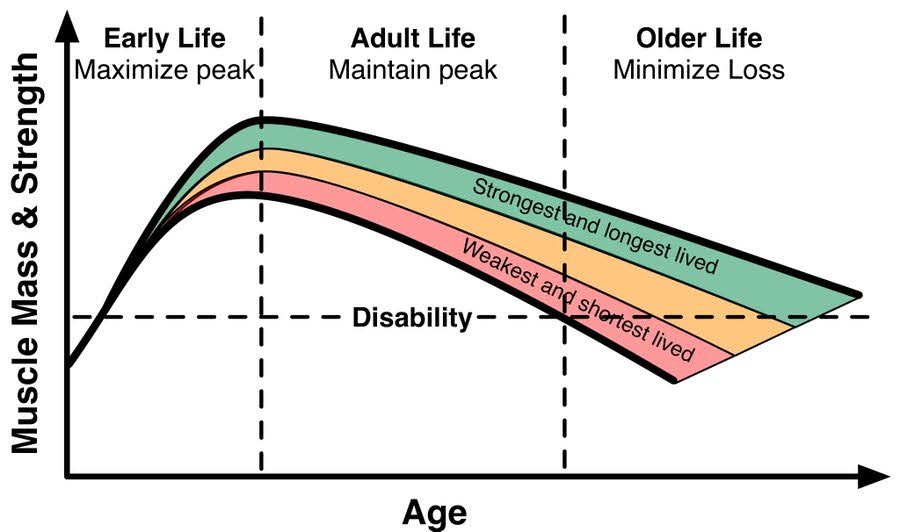
As long as you are increasing strength patiently and progressively, and not “number chasing,” your muscles, tendons, and connective tissues adapt extremely well to the stresses applied. The small risk of an occasional strain or minor injury is massively outweighed by the long-term benefits of being stronger — both for golf performance and overall health.
Research consistently shows that properly performed strength training has a lower injury rate than almost every other sport, including golf itself (Keogh & Winwood 2017). Strength-training-related injuries can almost always be traced back to training errors — insufficient warm-ups, too rapid an increase in training loads, trying to squeeze out “one more rep” when technique has broken down, or ignoring early signs that something isn’t feeling right.
There will come a time when progress slows, and you may only make small increases over long periods. Or you may be training hard and simply maintaining. That is completely normal once you are years into your training. By that stage, you will have already transformed your physical capabilities, and maintaining those levels is an enormous advantage for golf performance and long-term health.
Strength Benchmarks
The table below outlines realistic strength training standards for golfers (and non golfers). These are not powerlifting numbers, they reflect what is generally attainable for a normal person.
If you’re carrying 20, 30, or 50 lbs of extra body fat, these relative strength levels may seem very high. They’re well within reach for lean, well-trained people.
These aren’t requirements for elite golf. Many current and past world class players would not even be at level 2 (and maybe level 1 in some circumstances). Real strength training is still not popular at the tour level, and I think it is low hanging fruit for improved performance and longevity. Whilst “working out” and exercising has become popular on tour, trying to get really strong for the most part has not. That is changing more and more though!
These benchmarks are simply reference points to help you see where your training stands and where you might still have room to improve.
If you are below where you would like to be, don’t worry. Strength can increase massively with 6mo–1 year of well-structured, high effort strength training, and you can look forward to big improvements.
Before getting upset or argumentative about these numbers, which is common anytime I post benchmarks like these, please make sure to read: Strength Training vs Exercising With Weights
What Do Strength Levels 1, 2, and 3 Mean?
These levels represent general milestones in relative strength development for golfers (and non golfers). They provide a useful reference point for understanding how strong you are relative to your bodyweight. I would like to reiterate again, none of these levels are a requirement for great golf. I do think aiming to get significantly stronger would be beneficial for the vast majority of golfers. Especially if they are considering the level of golf they would like to be capable of in their senior years.
The timelines below assume consistent, progressive strength training with competent technique, and a very high effort level.
Level 1 – Good Base
Typical training history ~6–12 months of consistent strength training 2-3 x week
At this level, the trainee has built a solid base of strength and movement competency in the main patterns used in the gym.
Reaching Level 1 typically means you can:
- Perform the major lifts with good technique and are comfortable straining against challenging load
- Tolerate regular strength training without excessive soreness or fatigue
- Begin incorporating more challenging strength and power exercises
For many golfers who are new to strength training, reaching Level 1 represents a major improvement in general physical capacity. Improvements in the initial stages of training are usually very rapid.
Level 2 – Intermediate Strength
Typical training history – 1–3 years of consistent strength training 2-3 times per week
Level 2 represents very good relative strength compared to the general population. It is very attainable for the vast majority of people, but will not happen by accident. The casual gym goer or person who simply “lifts some weights” which will not achieve this. It requires real training, with a proper plan, done very consistently. Training sessions need to be a serious part of your week.
Golfers at this level have developed the ability to produce substantial force relative to their bodyweight and typically have a well-established training routine.
For most golfers, reaching Level 2 strength in the major exercises provides enough strength to support high levels of golf performance and club head speed, and means a good level of strength has been built to help fight the decline that comes with age.
Level 3 – Advanced Strength
Typical training history ~3–5+ years of consistent progressive training 3+ times per week
Level 3 represents advanced relative strength levels that are typically achieved by highly dedicated athletes or individuals with a long strength-training history. Not everyone will get here, and that is OK.
Reaching Level 3 requires:
- years of progressive overload
- consistent training habits
- well-developed technique in the major lifts
- Training being a priority in your life
Once these levels or close to them have been reached, there will be no further benefits in golf performance or club head speed from additional marginal gains. Time would be better spent working on swing technique, swing speed training, rate of force development. This is the very tip of the spear. Most of you reading this do not need to worry about level 3!
A Practical Target for Most Golfers
A realistic goal for most golfers is to surpass level 1 and reach level 2 strength in the majority of these exercises. This represents a high level of general strength and usually reflects several years of consistent training.
Beyond that point, further improvements in golf performance are often driven more by improvements in power, speed, and skill development rather than simply increasing maximal strength.
The table below represents 5RMs — the most weight you can successfully lift for 5 repetitions with good form.
Strength Standards for Golfers
| Exercise | Level | Male | Female | Male 60+ | Female 60+ |
| Squat (to breaking parallel) | Solid | 1.0×BW | 0.8×BW | 0.8×BW | 0.7×BW |
| Strong | 1.5×BW | 1.2×BW | 1.2×BW | 1.0×BW | |
| Very Strong | 1.75×BW | 1.4×BW | 1.3×BW | 1.2×BW | |
| Barbell Split Squat | Solid | 0.8×BW | 0.7×BW | 0.65×BW | 0.6×BW |
| Strong | 1.1×BW | 0.9×BW | 0.85×BW | 0.75×BW | |
| Very Strong | 1.3×BW | 1.05×BW | 0.95×BW | 0.85×BW | |
| Hex Bar Deadlift | Solid | 1.25×BW | 1.0×BW | 1.0×BW | 0.9×BW |
| Strong | 1.75×BW | 1.4×BW | 1.4×BW | 1.2×BW | |
| Very Strong | 2.0×BW | 1.7×BW | 1.6×BW | 1.4×BW | |
| RDL | Solid | 1.1×BW | 0.9×BW | 0.9×BW | 0.8×BW |
| Strong | 1.6×BW | 1.3×BW | 1.2×BW | 1.1×BW | |
| Very Strong | 1.9×BW | 1.5×BW | 1.4×BW | 1.2×BW | |
| Bench Press | Solid | 0.75×BW | 0.5×BW | 0.6×BW | 0.5×BW |
| Strong | 1.0×BW | 0.7×BW | 0.8×BW | 0.65×BW | |
| Very Strong | 1.25×BW | 0.85×BW | 0.9×BW | 0.75×BW | |
| Pull-Up | Solid | 1 rep @ BW | 1 band-assist rep | 1 band-assist rep | 1 band-assist rep |
| Strong | 5 reps @ BW | 2–3 reps @ BW | 1–2 reps @ BW | 1 rep @ BW | |
| Very Strong | 5 reps @ 1.2×BW | 5 reps @ BW | 3 reps @ BW | 2–3 reps @ BW | |
| Single-Arm Row (DB) | Solid | 0.3×BW | 0.22×BW | 0.27×BW | 0.2×BW |
| Strong | 0.4×BW | 0.3×BW | 0.36×BW | 0.27×BW | |
| Very Strong | 0.5×BW | 0.4×BW | 0.45×BW | 0.36×BW |
Key Takeaways for “How Heavy Should I Lift?”
- Heavy is relative. Start light, focus on good technique, and add small amounts of weight over time.
- Track your training. If the numbers aren’t increasing, you’re maintaining, not improving.
- Progressive overload drives every long-term gain in strength.
- You won’t get “too strong.” The goal isn’t to lift the heaviest weights possible, it’s to increase what your body can do so every swing you make has more potential behind it.
Getting seriously strong requires serious effort, and it’s worth it.
To learn more about strength training for golf, check out my most comprehensive article on the subject, Strength Training For Golf – The Fit For Golf Guide.
Reference: Keogh JW, Winwood PW. Epidemiology of injuries in powerlifting and weightlifting: a systematic review. J Strength Cond Res. 2017.