This article is broken into three sections. The first is the science behind the physiological decline senior golfers face. It’s important to understand this, as you will then know why I suggest the training protocols I do.
The second section explains the physics that determine swing speed in a way that makes it very simple to understand how your strength and mobility influence your ability to produce it.
The third and final part of the article lays out the exact type of training program that is most beneficial for gaining swing speed, and maintaining it. There is a huge added benefit to this type of training, it’s also exactly what we need to do to combat aging and improve our health span.
Why Senior Golfers Lose Swing Speed
There are well understood physiological adaptations that occur during aging that explain the decline in club head speed. Below are some of the most impactful ones.
Decrease in Muscle Activity / Neural Drive
To carry out a movement, our Central Nervous System (CNS) must activate motor units (MU’s). Motor units are composed of a motor neuron (nerve), and the muscle fibers that it innervates. In an effort to avoid complexity, the more MU’s that are recruited, and the faster that these signals to recruit MU’s are sent from the CNS, the stronger and faster our movements can be. This is extremely important for generating high club head speed. It has been well established that as one ages there is a loss in working MU’s which means generating high levels of force and speed becomes more difficult.
Shift in Muscle Fiber Type
Going quickly back to MU’s, it should be noted that all muscle fibers in a MU are the same type. You have probably heard of “fast twitch” and “slow twitch” muscle fibers, and these differences in muscle fiber type are very real and very important. Fast twitch muscle fibers are capable of much faster, and stronger contractions, and are therefore highly relevant for creating club head speed. It is well established that as one ages, there is a disproportionate decrease in the size and amount of these fast twitch muscle fibers compared to slow twitch fibers. There is also some debate that fast twitch fibers start to “convert” to slow twitch fibers, and become innervated by a slow twitch neuron. Slow twitch muscle fibers are great for endurance activities, but not an explosive action like the golf swing. Interestingly, slow twitch fibers don’t degrade anywhere near as much with age, compared to the fast twitch counterparts (Grosicki et al 2022).
There is an encouraging detail in this research. When individual fast twitch fibers from older adults are tested, they shorten just as quickly and produce just as much force for their size as fibers from young adults. The fibers themselves have not lost their ability to contract fast. They are simply smaller, and there are fewer of them. The whole muscle gets slower because of what has been lost, not because what remains has stopped working properly.
Power Declines Faster Than Strength
Many of you may be familiar with sarcopenia, the term used to describe the loss of muscle mass with age. Dynapenia, describes the loss of muscle strength with age. A recent paper proposes a third term, powerpenia, to specifically describe the loss of muscle power with age (Freitas et al 2024). The researchers argue that power declines faster than strength, which declines faster than muscle mass, and that each quality is distinct enough to deserve its own definition and its own training focus. They are all related however, and the training for each of them has crossover.
Muscle power, which is a combination of force and velocity, does not receive the same attention as muscle mass and strength but it certainly warrants it. Due to the selective atrophy and loss of fast twitch fibers, and other more complex nervous system factors, muscle power is lost at approximately twice the rate of muscle strength (Skelton et al 1994).
This is a very important point to note if maintaining high club head speed is a goal. With similar levels of muscle mass, and maximum strength, more senior populations tend to have much lower power levels. So even though someone may feel or look “in shape”, if they have not been specifically training it’s likely their power and speed has degraded.
The good news is this can be safely trained at any age!
The Physics That Determine Swing Speed
I do not want to bore you with physics equations, but understanding what actually dictates swing speed makes it possible to understand exactly how your body is influencing it.
Swing speed is primarily determined by:
a) The length of the hand path in the downswing (which is dictated by how far the hands travel in the backswing)
Multiplied by
b) The average force applied along this hand path
Hand path length (a) x average force (b) = the amount of work done on the club. The more work done, the more energy in the club head, which we measure as club head speed at impact. You will also hear this framed as impulse, force multiplied by the time it is applied for. Same idea, different angle.
Consider hand path length as a runway. With a longer runway, we have more time to accelerate. This is why hip, thoracic, and shoulder mobility are important. They provide us with the physical requirements for a longer hand path.
Another analogy we can learn from is wedge play. By changing how far we move our hands in the backswing when chipping or pitching we can drastically alter the club head speed at impact, without trying to apply more force. This is due to having more time to apply force during the downswing. We can use this same concept when trying to increase club head speed in the full swing. Usually get your hands to 10 o’clock? Get them to 10:30 or 11 o’clock and your club head speed will likely increase.
The average force applied will be dictated by the kinematic sequencing of your swing – which is essentially how effectively you use the physical capabilities you have, the explosive capabilities of your nervous system and muscles, and your level of effort.
Here is a passage from Sasho MacKenzie’s paper “How Amateur Golfers Deliver Energy to the Driver” that sums up these concepts:
“The average force applied in the direction of travel of the hand path was by far the biggest discriminator in separating individuals with different levels of clubhead speed, as it predicted 92% of the variability. From a practical standpoint, knowing that a higher level of average force most likely explains differences in clubhead speed does not suggest a clear path for an instructor, or golfer, trying to increase clubhead speed. The reason is that a higher average force could be the result of several diverse factors such as swing coordination, level of exertion, and the force generating capabilities of the primary muscles involved”.
Just to be clear on what that 92% figure means. This is when comparing different golfers. It does not tell you where your own biggest gains are. Additionally, there are certain elements of technique adjustment that change hand path length and average force.
For example, allowing the lead heel to lift enables the hips and torso to rotate more, and lets the hands travel further. This is often worth 3 to 5 mph of swing speed immediately. It’s easy to think of this technique adjustment as an increase in hand path length, which it is, but it also brings the pelvis and torso muscles into play more, so average force tends to go up at the same time.
If your muscle power declines, from a combination of neural drive, reduction in the size of your fast twitch fibers, and how many of them you have, then the average force you can produce along that hand path declines with it. That is the third factor MacKenzie lists, the force generating capabilities of the muscles, and it is exactly what we covered above.
If your mobility declines, your hand path will probably get shorter, or you will need to find less efficient ways to create it.
Get stronger and get more mobile, and you can have a longer swing with stronger, more powerful muscles driving it. Club head speed goes up.
Read our Fit For Golf Guide – Swing Speed Training For Golf.
The Training: Four Things To Focus On
1. Maximum Strength
Maximum strength, the peak force your muscles can reach, plays an important role in how much force you can apply in the golf swing.
Maximum strength is best trained with heavy loads, relative to your strength level. This equates to a weight you can lift for no more than 8 repetitions per set. My preference is to train maximum strength with simple compound lifts.
If you are deconditioned, inexperienced, or carrying old injuries, strength training should be eased into conservatively. When you are new to strength training, the most important thing is not trying to do too much too soon. Start at a comfortable level, and add a little bit of weight each workout, or each week. Slowly and steadily adding weight is the key.
Example Exercises:
Lower Body – Squats, Leg Presses, Split Squats, Deadlifts
Trunk – Cable Pulley Rotations, Weighted Side Bends, Weighted Back Extensions (slightly higher reps work better for these, more like 8-10)
Upper Body – Bench Press, Shoulder Press, Pull-Ups, Rows
2. Rate Of Force Development
Heavy strength training is very beneficial for increasing swing speed, but for best results we should also be working on producing force or “applying strength” at faster rates. This is termed Rate of Force Development. Producing high club head speed relies not just on strength, but how quickly we can produce it.
This is where high speed exercises shine!
For this element of your training we use exercises where you are moving light or no weight, in movements that let you move extremely quickly. Even though the weight is just your bodyweight or a very light implement, like a 4lb medicine ball, the reps per set are kept at about 6 per set. This is because we want to keep all reps in a set at near maximal speed. In these sets you won’t be “feeling the burn” or coming close to failure, as that would train endurance rather than explosive power.
The key in these exercises is maximal effort on every rep. Muscle fibers are recruited on an intent basis. Without maximum intent the crucial fast twitch muscle fibers in the muscle are not recruited or trained. Learning how to recruit these fibers and developing them is one of the main training adaptations we are trying to stimulate.
This is really important to understand because it highlights training is not just about the exercises we choose, it’s also about how we do them.
You can pick a “good exercise”, do it with less than maximum intent, and not get the desired benefits from it.
This is the element of training most people skip entirely. Watch people train and you rarely see anybody over 40 or 50, never mind 60 to 80, throwing a medicine ball, jumping, or moving with any explosive intent. You will see steady state cardio, stretching, some light and some slow tempo weight lifting. Almost nobody trains in an explosive fashion.
To remain explosive we must train like explosive athletes do, scaled to our current ability level.
Example Exercises:
Lower Body: Explosive sit to stands, low box jumps if you can tolerate jumping, explosive kettlebell swings, short sprints or bike sprints of about 5 seconds
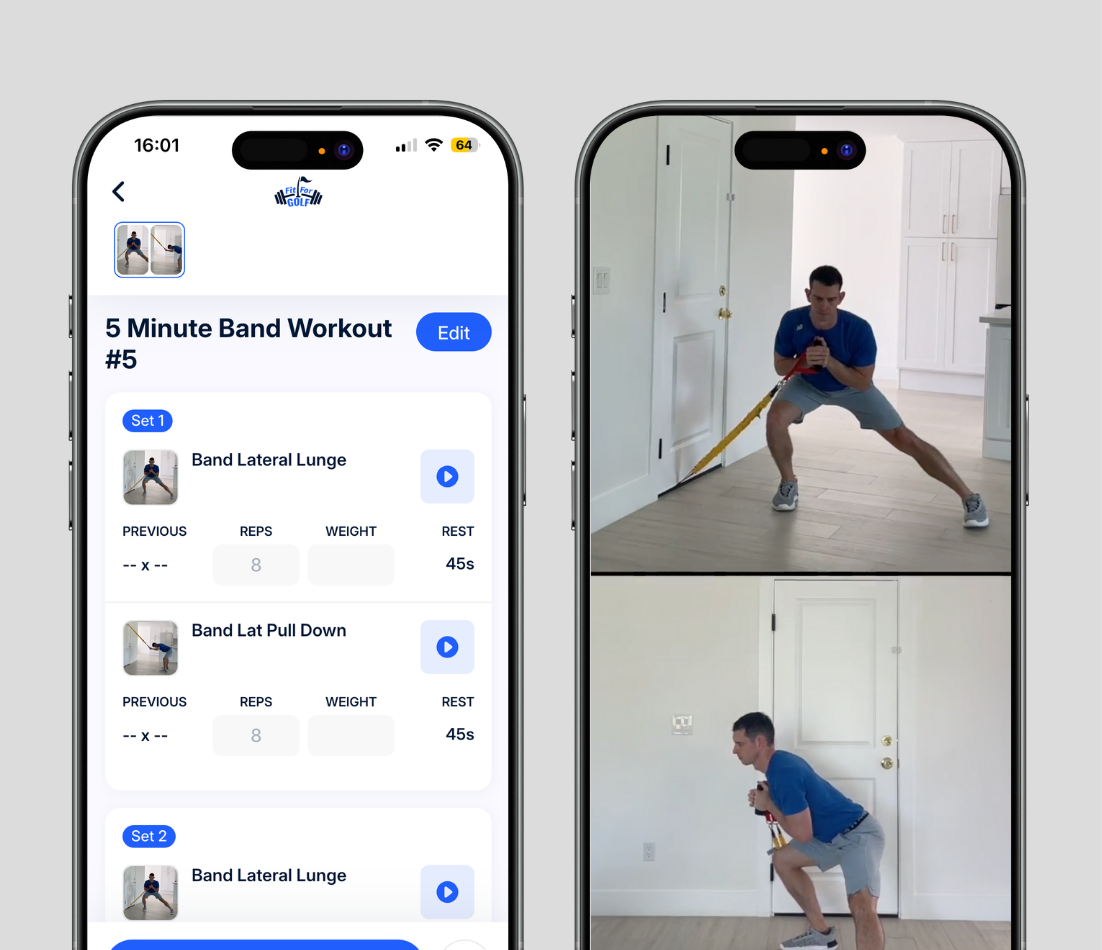
Trunk & Upper Body: Medicine ball throws and slams, high speed band or cable pulley rotations and chops
Trunk & Upper go together in this section because a lot of exercises used in “explosive training” are really full body exercises. Medicine ball throws and slams being a great example.
3. Swing Speed Training
By “swing speed training” I mean swinging your driver or a speed training tool like The Stack System, with the goal of generating high club head speed, with a radar for feedback. When this is suggested, a common reply is, “but what about my technique, I will ruin my swing”. This is usually the opposite of what happens. In general, when people develop the ability to move the club head faster through the impact area their mechanics improve.
The best analogies for this type of speed training are a sprinter doing sprints of a set distance with a stopwatch for feedback, or a pitcher throwing pitches with a radar gun for feedback.
The simple act of performing the actual sporting skill, with the intent of increasing the input can be a very potent form of training.
It’s a very important part of the training plan as it gives you a chance to practice transferring the physical capabilities you have built through mobility, strength and power training into the specific motion of the swing.
Our workouts are primarily general physical development. We are enhancing our body’s capabilities. Swing speed training allows us to practice expressing our new capabilities in the motion we actually want to get better at. It is both physical development, and swing training.
I like to combine speed training with a driver and ball, and speed training without a ball. This can be done with a variety of “dry swing drills” and with The Stack System. The reason for this is that some golfers really struggle to swing anywhere near their speed capacity when a ball is present. Even in practice, they have a mental block that inhibits them from opening up, due to the fear of a poor outcome.
Removing the ball, and even changing the implement in the golfer’s hand can encourage them to actually work on delivering more speed, and then doing so when a ball is present can be worked back in.
Fear of a poor result makes golfers constrain their swing length and effort, which puts them in a straitjacket. The single goal of swinging the stick / club fast with the shot outcome removed tends to produce a much more athletic move.
This can be done on the same day as your workouts – before the workout, or on the days in between.
After a thorough warm-up about 15-20 “speed training swings” 2-3 x week is a great place to start. Take about a 30 second break between swings, and record your scores. The goal is to see your average and maximum speed increase. There is a swing speed tracking feature in the Fit For Golf App. Remember, for speed training, a radar is essential. I recommend the PRGR, or The Stack Radar.
4. Mobility
From MacKenzie’s paper we know that increasing hand path length can increase swing speed. If we increase this hand path length by increasing pelvis and torso rotation and allowing the lead heel to raise it can also improve average force, as our big trunk muscles are better engaged. A golfer may not need more mobility to do this though, it may simply be a matter of technique adjustment.
If however a golfer is limited in their range of motion, then working on mobility can make a big difference. In general, the hips, thoracic spine, and shoulders are the key areas to focus on.
The key point to remember with mobility training is that it only helps swing speed if it leads to an adjustment in the mechanics mentioned above. This is different to increasing physical power, where you simply have more force available even if the mechanics don’t change.
Mobility is targeted comprehensively in the programs on the Fit For Golf App, both with warm-up exercises, and weighted mobility & strengthening exercises.
Mobility can also be targeted nicely with exaggerated swing drills. Here is a simple one that works well.
Top of backswing pulses. Get to the top of your backswing and do small reps pushing the range a little further.
Check out our blog post – Golf Flexibility Exercises: 3 Stretches for a Better Backswing.
Training To Increase Swing Speed – A Sample Week
I split this sample week up into “workouts” and “specific speed training”.
Workouts
I recommend three gym or home based Fit For Golf workouts per week. These will be full body workouts, with all of the important elements mentioned in the article covered: a dynamic warm up and mobility, explosive power work, and strength training.
Here is an example workout:
Part 1 · ~10 min
Dynamic Warm Up
Mobility work for the joints that matter, then bodyweight exercises to prime the muscles, connective tissue, and nervous system for training.
Thoracic spine
Shoulders
Neck
Toe touches
Push ups
Arm swings
Sample exercises. The app scales the right ones to you.
⚠ Pressed for time?Don’t skip the warm up. Adjust the number of sets you do in the workout instead.
Part 2 · Rate of Force Development
Power
Light or no weight, moved as fast as possible. This is the element that builds explosive ability. We lose it faster than strength or muscle, and most training programs neglect it entirely.
The Protocol
Why only 6 reps? Every rep needs to be at near maximal speed. You should not be feeling the burn or coming close to failure. That would train endurance rather than explosive power.
One exercise for each area, run as a circuit
Lower
Explosive sit to stands, low box jumps, or explosive kettlebell swings
Trunk
Medicine ball throws and slams, or high speed band and cable rotations
Upper
Hands elevated ballistic push ups
The key pointMaximum intent on every rep. Fully recovered between sets, with no drop off in speed.
Part 3 · The Main Course
Strength
Progressive strength training is critical for building and maintaining muscle mass and strength, both of which matter for your health and your long term golf. The most efficient way to cover the major muscle groups is with compound movements that work a lot of joints and muscles at once. I focus on five primary movement patterns.
Per Main Lift
Why no more than 8? Heavy enough, relative to your strength level, to build strength and target the neural qualities, while still letting you accumulate enough volume to build muscle.
A sample session covering the five patterns
Machine, dumbbell or barbell variations all work. Cable rotations suit slightly higher reps, around 8 to 10.
Pro Tip · SupersetsPair a lower body lift with an upper body lift. Leg press, chest press, leg press, chest press. Better recovery, same total time.
Swing Speed Training
For senior golfers trying to increase swing speed I recommend two to three swing speed training sessions per week. Go through the same dynamic warm up as for the workouts, then do 15 to 20 swings where you try to register as high a club head speed as possible.
This doesn’t have to be done as a stand alone session, it can easily be implemented as part of a golf practice session, or done after a round. One of the benefits of doing it as part of a golf practice session or after a round is that you are already warmed up.
These speed training sessions can also be done on the same day as a workout, or even as part of a workout if you workout at home or somewhere you can swing. In these cases, the speed training should be done after warming-up, but before the rest of the workout.
Swing Speed training can be tracked in the Fit For Golf App.
Putting It Into A Week
Putting It Together
A Sample Week
Three workouts and three speed sessions, alternating through the week.
Fitting golf around itGolf practice and play can be done as normal on any day. I recommend workouts and/or speed training to be done after golf practice or play if being done on the same day.
The Fit For Golf App
Everything In This Article, Programmed For You
Full body workouts built around strength, power and mobility, scaled to your level and your equipment. Follow along on your phone, in the gym or at home.
★★★★★ 4.9 on the App Store from over 1,100 reviews
My swing speed with driver has increased from 83mph to 87mph. I recently went on a golf trip and played 7 rounds on 7 consecutive days, walking the middle 3. The Fit For Golf App certainly helped make this possible.
Bob
I am 77 years of age and have been using the Fit For Golf App for 3 years. I have lost close to 70lbs, my strength levels have increased, and my handicap has reduced from 16 to 8.
Paul Brumbley
My average driver club head speed has increased by 10mph. I am at least 20 yards closer to the green off the tee. You have opened my mind to the possibilities.
Ronan Lyden
Frequently Asked Questions
Is it too late to start at 60, 70, 80 years of age? No. Great progress can be made at any age. The key is starting conservatively and slowly building up. Thousands of senior golfers of all ages and fitness levels have made great progress using the Fit For Golf App.
There is also a lot of scientific research to back up how older adults can make big progress. In one study (Wang et al 2017) a group of men with an average age of 72 trained three times a week for 8 weeks, and their strength and rate of force development ended up similar to a comparison group with an average age of 24. Maximal strength increased by 68%, rate of force development by 48%, and the size of their fast twitch muscle fibers by 66%.
How much swing speed can a senior golfer gain? It is common for senior golfers to gain 5mph of swing speed within about 6 weeks training, and up to 10mph in one year.
Should seniors focus on mobility or strength? A combination of both, but in general, senior golfers over emphasize mobility and under emphasize heavy strength training. Also, as you learned in the article, we need to combine heavy strength training with explosive power training.
Is lifting weights safe for older golfers? Yes, and it’s one of the most impactful things you can do for your golf game and overall health and function. The NSCA’s position statement on resistance training for older adults reports just one case of shoulder pain across 20 studies and over 2,500 frail adults aged 70 to 92. Start conservatively, build up gradually, and it’s about as safe as training gets.
References
Freitas, S.R., Cruz-Montecinos, C., Ratel, S., & Pinto, R.S. (2024). Powerpenia Should be Considered a Biomarker of Healthy Aging. Sports Medicine Open, 10, 27.
Grosicki, G.J., Zepeda, C.S., & Sundberg, C.W. (2022). Single Muscle Fibre Contractile Function with Ageing. The Journal of Physiology, 600(23), 5005-5026.
Skelton, D.A., Greig, C.A., Davies, J.M., & Young, A. (1994). Strength, Power and Related Functional Ability of Healthy People Aged 65-89 Years. Age and Ageing, 23(5), 371-377.
MacKenzie, S., McCourt, M., & Champoux, L. (2020). How Amateur Golfers Deliver Energy to the Driver. International Journal of Golf Science, 8(1).
Wang, E., Nyberg, S.K., Hoff, J., Zhao, J., Leivseth, G., Tørhaug, T., Husby, O.S., Helgerud, J., & Richardson, R.S. (2017). Impact of maximal strength training on work efficiency and muscle fiber type in the elderly: Implications for physical function and fall prevention. Experimental Gerontology, 91, 64-71.
Fragala, M.S., Cadore, E.L., Dorgo, S., Izquierdo, M., Kraemer, W.J., Peterson, M.D., & Ryan, E.D. (2019). Resistance Training for Older Adults: Position Statement From the National Strength and Conditioning Association. Journal of Strength and Conditioning Research, 33(8), 2019-2052.