This short article is derived from Strength Training For Golf – The Fit For Golf Guide. That article goes into detail on everything you need to know about strength training for golf. In this shorter piece, I am providing theoretical knowledge about exactly what happens as a result of strength training.
Finding the Right Starting Weight
This applies to the vast majority of exercises. Choose a weight you are sure you can lift for five reps. Perform five reps, and based on how it feels, add a little more weight, still being confident you can do five reps. Repeat this a couple more times and you will find a weight that is of moderate difficulty for five reps.
A good weight to stop at is one that you lifted for five reps, and if you absolutely had to, you maybe could have lifted for seven or eight. This is about three reps in reserve and a nice intensity level to start with.
If you are a complete beginner, go even easier for the first few sessions. Finishing each set with three or four reps left in the tank is fine. It is better to start too light and progress gradually than to overdo it early and stall or get hurt.
If you are new to training, you will get stronger quickly. The goal from here is to add very small weight increments in each workout until you cannot. In the next sections I will explain this method, and another progression method, in more detail.
Simple Linear Progression
For this example, let’s imagine you have determined that 95 lbs for 5 reps is an appropriate starting weight on the bench press. You successfully complete 3 sets of 5 reps with this weight and feel like there was room for a little more weight.
Perfect. Next session, add a small amount of weight, maybe 5 lbs, so you’re up to 100 lbs. If you can still complete three sets of five, increase again the following session to 105 lbs. These small, steady jumps might not sound like much, but they add up quickly. That’s progressive overload in action.
In simple terms for linear progression:
- Use a weight that allows 3 sets of 5 reps.
- If it feels easy, add a small amount of weight in the next session.
- Keep increasing gradually until 3 sets of 5 reps is right at your limit.
- Whenever possible, add another small increment.
You will reach a point where 5-pound, and even 2.5-pound, jumps from session to session are too big. When exactly this happens will depend on the exercise and your training experience.
Adding 5 lbs to a 200 lb load is a much smaller percentage increase than adding 5 lbs to a 50 lb load, and will be sustainable for much longer. It’s a good idea to think about weight increases in percentages rather than absolute amounts. Increasing a dumbbell lift from 20 lbs to 25 lbs feels much harder than increasing a barbell lift from 200 lbs to 205 lbs. It’s the same 5 lb increase, but a completely different relative increase.
Double Progression Method
You will eventually reach a point where you hit a plateau with the linear progression method outlined above. This is completely normal. Strength increases slow down drastically after the first few months of training. When this happens, the double progression method is an excellent option.
- Start with a weight you can lift for 3 sets of 5.
- Stay with that weight until you can do 3 sets of 8. This may take many sessions.
- Once you can complete 3 sets of 8 reps, increase the weight so that in your next session you are back to 3 sets of 5 reps with a heavier load than before.
- Keep repeating this process.
This method gives you more time to stimulate the adaptations necessary to go up in weight, which becomes increasingly important as progress slows down.
The key with both methods is that there is a clear plan and intent to gradually increase the weight you are using.
Why We Need Progressive Overload
The ability to use more load over time is what proves you are stimulating adaptation.
Gradually adding load over time, is the best proof that you are stimulating strength adaptations.
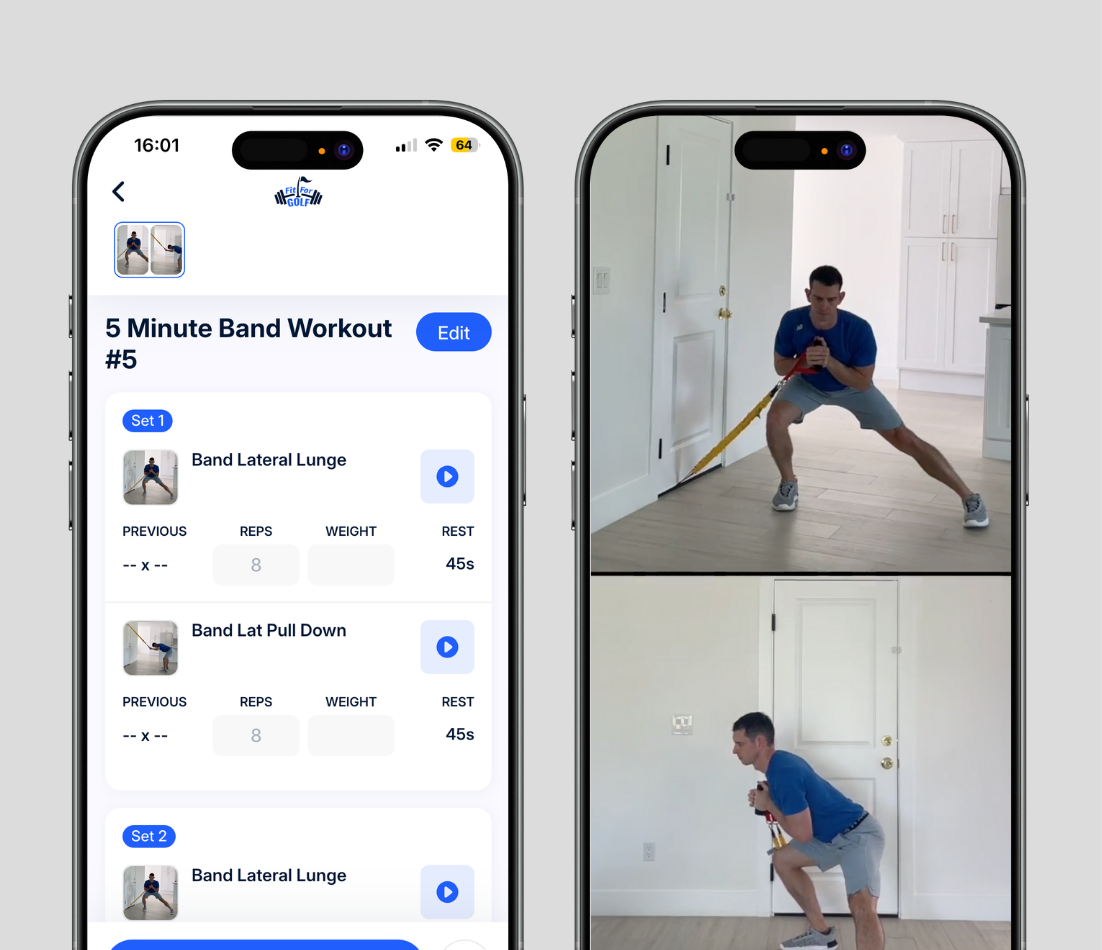
This ties in with why tracking your training is so important. The Fit For Golf App prescribes crystal clear instructions on exactly what to do in each workout, and makes it simple to record the weight used and reps completed for each set. The progress section allows you to monitor your strength (and club head speed progression) over various time periods.
If the numbers aren’t moving up over time, that’s feedback that something needs to change. Or, you may be at a point where you are just happy to maintain, that’s OK too.
If you want to see how these concepts are applied to designing training programs, and learn more about strength training for golf, check out my most comprehensive article on the subject, Strength Training For Golf – The Fit For Golf Guide.