If you’ve spent years trying to improve your mobility through stretching but still feel restricted in your golf swing, you’re not alone.
Many golfers assume poor mobility comes down to one thing: tight muscles. While muscle and connective tissue play a role, they are only one piece of a much larger puzzle.
In reality, mobility is influenced by several factors, and understanding them is one of the fastest ways to stop wasting time on ineffective routines and start making meaningful progress.
This article focuses on one of the biggest misconceptions surrounding golf mobility. If you’d like a complete breakdown of mobility for golf, including club head speed, mobility assessments, swing limitations, and practical programming, check out the Mobility For Golf – The Fit For Golf Guide.
Mobility Is About More Than Muscle Length
When golfers think about mobility, they usually assume the problem is simple:
“My muscles are tight.”
That can be part of the picture, but it is rarely the main reason someone is restricted in a movement.
Mobility is influenced by three primary factors:
- The nervous system
- Muscle and connective tissue
- Joint structure and anatomy
Understanding these factors makes mobility training far more effective. It also prevents golfers from chasing the wrong solutions and, in some cases, irritating joints that were never meant to move further in the first place.
The Nervous System’s Role In Mobility
One of the most overlooked influences on mobility is the nervous system.
Your brain ultimately decides how far you are allowed to move. If a position feels unfamiliar or potentially risky, the nervous system limits access to that range as a protective response. It is essentially saying, “That’s far enough for now.”
This is why range of motion can improve very quickly during a warm-up. Your tissues are not changing meaningfully in a few minutes. What is changing is your nervous system’s willingness to allow movement into those positions.
You can demonstrate this easily. If you stand up and perform 10 slow, deep squats, you will often notice that each repetition feels easier and allows slightly more depth. Your muscles have not lengthened in those few seconds. Your brain has simply registered that the movement is safe.
Most golfers have not shown their nervous system that they can control the ranges they already possess. Gradually moving through deeper ranges, and doing so regularly, allows the nervous system to relax its protective response and makes existing range easier to access.
Muscle And Connective Tissue Still Matter
While the nervous system plays a major role, tissues matter too.
Tissue adapts to what it is exposed to. If certain ranges of motion are rarely used, especially rotational end ranges, the muscles and connective tissue involved become comfortable operating at shorter lengths and less tolerant at longer ones.
This is not damage or dysfunction. It is a normal adaptation.
Most golfers spend decades in a small number of postures. Sitting dominates daily life. Rotation is limited. Arms rarely go overhead fully. Joints are rarely challenged near the ends of their available range.
Over time, tissues adapt to this lack of exposure. Rotational end ranges begin to feel foreign, muscles become less comfortable at longer lengths, and the sensation of stiffness increases.
The encouraging news is that tissue also adapts when you train it.
When joints are gradually taken toward their end ranges under control, tissues become more tolerant to stretch and tension, develop strength in positions that previously felt weak, and become more comfortable operating at longer lengths.
This is one reason active mobility work and strength training through large ranges of motion can be so effective.
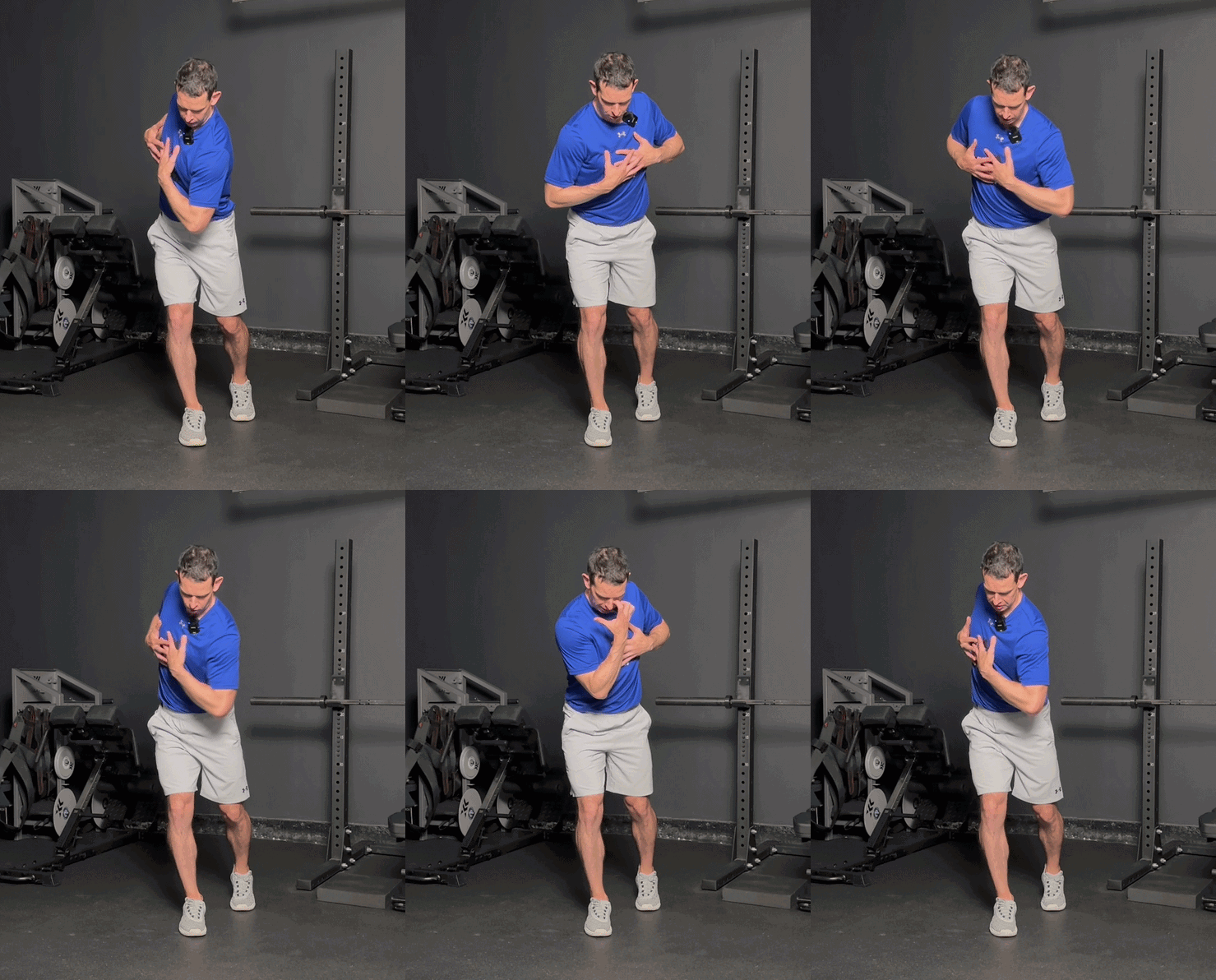
Free 10 Minute Follow Along Mobility Routine
Follow along with Mike through this free 10-minute mobility routine designed to improve range of motion between workouts.
Some Mobility Limitations Are Structural
There is another factor that stretching cannot change.
Joint structure places real constraints on how much motion is available. Bone shape, socket depth, and joint orientation all influence how far certain joints can move.
Hip rotation is the clearest example. Some golfers naturally have large amounts of internal or external hip rotation. Others reach a firm stop much earlier.
The same is true for the shoulder.
In these cases, trying to force more range will likely do more harm than good. You are attempting to change something with a relatively small adaptive capacity and may end up with irritation rather than improvement.
Signs of a structural limitation often include:
- A hard, unmistakable end-range block
- Deep joint pinching rather than a muscular stretch
- Little improvement after warming up
- Passive range equaling active range
Structural variation is normal and does not determine golfing potential. There are Hall of Fame golfers and major champions with average mobility.
The key is recognising what is modifiable and what is not worth chasing.
Key Takeaways
- Tight muscles are only one factor influencing mobility
- The nervous system often plays a major role in mobility restrictions
- Tissues adapt to the ranges they are regularly exposed to
- Some mobility limitations are structural and cannot be stretched away
- Stretching can be useful, but it is often overvalued as a long-term solution
If you want a deeper understanding of mobility for golf, including how it influences swing technique, club head speed, mobility assessments, and practical mobility training, check out the Mobility For Golf – The Fit For Golf Guide.